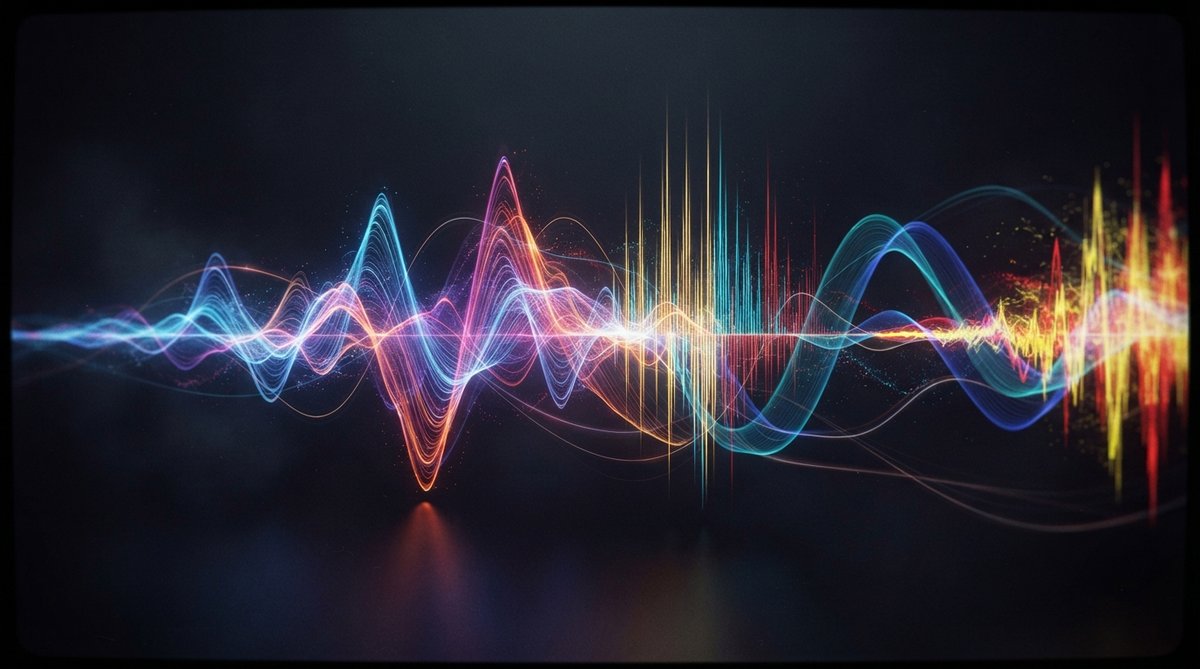
What Exactly is Timbre?
Timbre is what allows us to distinguish between different types of sound sources, even if they play the same pitch at the same loudness. It is the complex fingerprint of a sound, determined by several factors:
- Harmonic Content: The combination and relative strengths of overtones (harmonics) above the fundamental frequency. A flute sounds different from a clarinet playing the same note because their harmonic series differ.
- Attack and Decay: How quickly a sound begins and ends. A plucked string has a sharp attack and a rapid decay, while a bowed string has a slower attack and a longer sustain.
- Envelope: The overall amplitude contour over time, including sustain and release phases.
- Formant Structure: Resonant peaks in the frequency spectrum that define the characteristic sound of an instrument or voice.
The Psychoacoustics of Sound Color
Our brains are constantly interpreting these complex acoustic signals, translating them into perceived qualities. This process is part of The Role Of Psychoacoustics In Mixing, where our perception of sound is shaped by more than just raw physical properties. A sound with prominent high-frequency harmonics might be perceived as 'bright' or 'brittle,' while one with strong low-frequency content might be 'warm' or 'dark.' These perceptions are not purely objective; they are deeply intertwined with our cognitive and emotional processing.
Timbre is a powerful, subconscious conductor of emotion, guiding our feelings about a piece of music.
Timbre and Emotional Response
The emotional impact of timbre is profound. Consider these common associations:
- Bright, rich timbres like those from brass instruments or shimmering synthesizers often evoke feelings of excitement, triumph, or joy.
- Dark, sparse timbres from low strings, sine waves, or muted horns can suggest melancholy, mystery, or introspection.
- Rough, distorted timbres commonly found in rock guitars or aggressive synths convey aggression, tension, or power.
- Smooth, sustained timbres such as those from pads or bowed strings typically create a sense of calm, serenity, or solemnity.
Shaping Timbre in Practice
As producers and engineers, we constantly manipulate timbre to achieve specific emotional and aesthetic goals. This is a core aspect of sound design and mixing. Simple equalization can shift a sound from bright to dark, altering its mood. Creative filtering techniques are essential for sculpting unique tones Creative Filtering Techniques Sculpting Tones Beyond Basic Eq.
Saturation is another powerful tool for timbral shaping. By adding harmonics, a plug-in like Schulz PortaCrunch 424 can impart warmth, grit, or a vintage character, transforming a clean signal into something rich and expressive. Multiband saturation can add warmth and character to specific frequency ranges, allowing precise control over a sound's harmonic profile The Power Of Multiband Saturation Adding Warmth Character To Specific Frequencies.
Dynamic processors also play a role. OOMPH is a multiband dynamic enhancement tool that lets you refine and design individual sounds by independently enhancing frequency zones, controlling their saturation, balance, dynamics, and stereo width. This allows you to sculpt the impact and clarity of different timbral components. For broader control, mastering multiband dynamics helps shape your mix with frequency-specific control Mastering Multiband Dynamics Shaping Your Mix With Frequency Specific Control.
Modulation effects like chorus fundamentally alter a sound's timbre by adding movement and width. The JUNI 1984 CHORUS, for example, can create a lush, swirling texture that changes the perceived character of a synth or guitar. Understanding what a chorus effect is and how it adds width and movement is crucial for these applications What Is A Chorus Effect How To Add Width And Movement To Your Mix.
Spatial effects like reverb also dramatically affect timbre. A long, dark reverb from RedVerb 2 can make a sound feel distant and melancholic, while a short, bright reverb from JP-ME-1 might make it feel immediate and exciting. Exploring convolution reverb Convolution Reverb Explained Mastering Impulse Responses For Realistic Spatial Effects or the distinctive soundscapes of 80s digital reverb The Definitive Guide To 80S Digital Reverb Crafting Retro Soundscapes offers powerful ways to shape a sound's perceived color and space.
Visualizing Timbre
While timbre is ultimately perceived by ear, visual tools can help us understand its components. Oszillos Mega Scope provides a real-time visualization of waveforms, which can be useful for seeing the attack and decay characteristics that contribute to timbre [LINK:unlock-the-power-of-audio-analysis-with-oszillos-mega-scope]. Similarly, Spectrum 2 allows you to inspect the frequency content of your mixes, revealing the harmonic structure that defines a sound's color Beyond The Ears Using A Spectrum Analyzer For Precise Eq Decisions.
Mastering timbre means understanding both its sonic and emotional weight, then using that knowledge to craft impactful audio.
By paying close attention to timbre and its psychological impact, we can create more nuanced, expressive, and emotionally engaging music and soundscapes. It is a fundamental element of sound design that deserves careful consideration in every production.