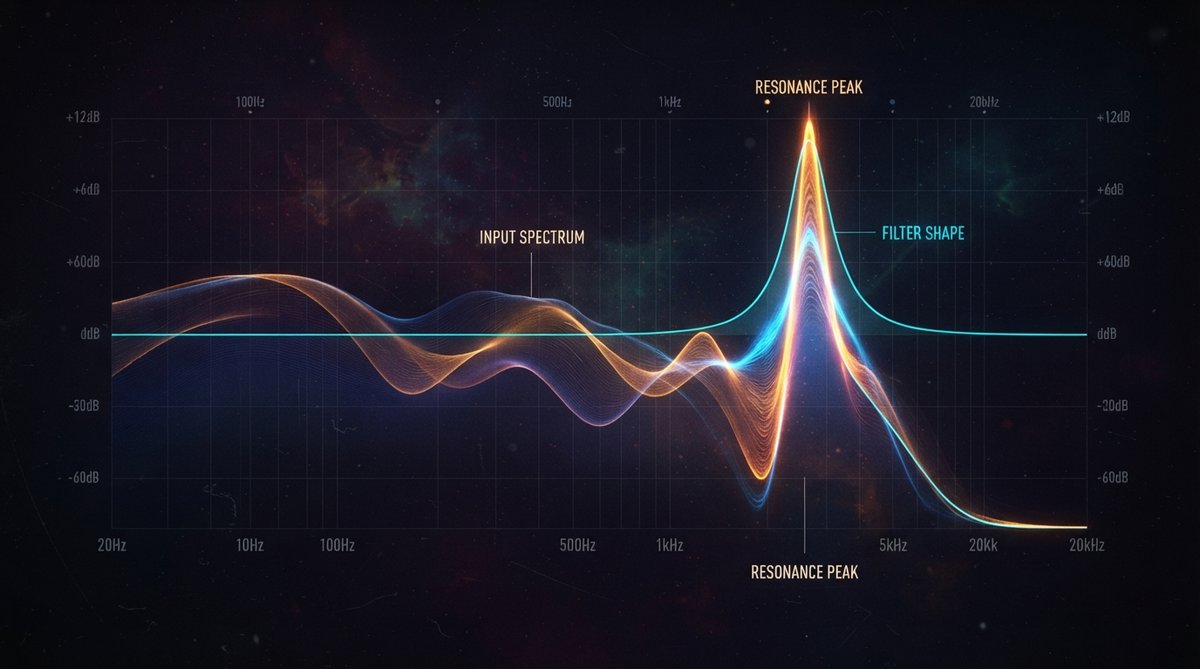
What Makes Filters Different from Standard EQ?
At its core, a filter is a type of equalizer, but it often features controls that encourage more dramatic and focused frequency manipulation. Unlike a typical parametric EQ that might have broad or narrow Q settings, filters often have very steep slopes (e.g., 12 dB, 24 dB, or even 48 dB per octave) and a prominent resonance control. This resonance amplifies frequencies around the cutoff point, creating a distinctive peak that can be swept for expressive effects.
Filters excel at creating dramatic frequency changes and adding movement, which standard EQs often cannot replicate with the same character.
Harnessing Resonance for Sonic Character
The resonance control is where filters truly become creative tools. By boosting resonance at the cutoff frequency, you can create a pronounced peak that emphasizes specific harmonics or creates a 'wah' or 'sweep' effect as you automate the cutoff. This is incredibly useful in sound design, from giving a bassline a throbbing pulse to making a synth pad shimmer. You can use it to highlight a particular element in a dense mix or to create rhythmic interest. Experiment with high-pass, low-pass, and band-pass filters with varying resonance settings to discover new sonic possibilities. When pushing these extreme settings, it is helpful to see what is happening. Spectrum 2 provides a clear visual representation of your frequency content, allowing you to observe exactly how your resonant filter is shaping the sound and identify any problematic build-ups. For a deeper look at managing frequencies, consider The Art Of Spectral Balance How To Achieve A Professional Sounding Mix.
Filters in Dynamic Sound Design
Beyond static tone shaping, filters are vital for dynamic sound design. Automate a low-pass filter to gradually open up a muffled sound, revealing its full spectrum for a sense of anticipation. Conversely, sweeping a high-pass filter upwards can thin out a track, creating space or preparing for a drop. This technique is common in electronic music but applies to any genre needing dramatic transitions. Filters can also be used subtly; for instance, applying a gentle, automated band-pass filter to a vocal during a specific phrase can give it a telephone-like quality, or using a high-pass filter on drums can thin out the low end for a break section, then bring it back for impact. To understand how these dynamic changes affect the overall waveform, Oszillos Mega Scope can show you the amplitude envelopes and phase relationships in real-time.
Shaping Effects with Filters
Filters are not just for source tracks; they are powerful tools for sculpting time-based effects. Applying a high-pass filter before a reverb or delay send can prevent muddiness and keep the low end clean, ensuring the effect only processes the desired frequencies. Conversely, filtering the output of an effect can create unique textures. For example, a heavily filtered delay or reverb can sound distant, ethereal, or lo-fi. Try adding a high-pass and low-pass filter to the output of a reverb like RedVerb 2 to create a narrow, mid-range-focused ambiance, or combine it with the classic 80s digital character of JP-ME-1 and then filter the tail for a vintage, almost muffled sound. This approach allows you to place effects precisely within the frequency spectrum of your mix. For more on reverb sculpting, check out Beyond The Basics Sculpting Reverb Size And Decay For Perfect Ambiance.
Multiband Filtering for Precision Tone Sculpting
While traditional filters apply across the entire frequency spectrum of a signal, multiband processors offer a more surgical approach. Tools designed for dynamic enhancement, like OOMPH, allow you to apply frequency-specific saturation, balance, and dynamics control across four flexible bands. This is a form of advanced filtering, letting you sculpt tones with incredible precision. Imagine boosting the punch in your kick drum's low-mid without affecting its high-end clarity, or adding warmth to a vocal's body without muddying the lows. This dynamic, frequency-aware processing takes tone sculpting to another level, adapting to your audio in real-time. Learn more about this technique in Mastering Multiband Dynamics Shaping Your Mix With Frequency Specific Control.
Do not just filter your source sounds; use filters to shape the character and placement of your effects for truly unique results.
Creative filtering is a vast landscape of sonic possibilities. By understanding the unique characteristics of filters, especially their resonance and steep slopes, you can move beyond corrective EQ and infuse your mixes with movement, character, and depth. Whether you are designing sounds from scratch or adding the final touches to a mix, filters are an indispensable tool for truly sculpting your tone.