What is Multiband Saturation?
Saturation, in its essence, introduces subtle harmonic distortion and gentle compression, often associated with analog gear. It can make sounds feel fuller, warmer, and more present. Traditional saturation applies this effect across the entire frequency spectrum. Multiband saturation takes this concept a step further by splitting your audio into several frequency bands, much like a multiband compressor or EQ. This allows you to apply varying amounts of saturation to the low, mid, and high frequencies independently.
Multiband saturation offers precise control, letting you add character to specific frequency ranges without affecting the entire signal.
Why Go Multiband? Precision and Control
The main advantage of multiband saturation over its broadband counterpart is precision. Imagine you want to add some grit to a bassline's mid-range to help it cut through a mix, but you want to keep the low-end clean and tight, and the high-end smooth. With a single-band saturator, you might end up muddying the lows or making the highs too harsh. Multiband processing solves this. You can dial in just the right amount of harmonic richness for each frequency zone, creating a balanced and impactful sound. This level of control is also invaluable when preventing Identifying And Fixing Frequency Clashes For A Crystal Clear Mix.
Adding Warmth and Character Where It Counts
Multiband saturation can be a powerful tool for shaping the tonal richness of individual tracks or even entire mixes. For instance, you can: * Enhance bass frequencies: Add subtle harmonics to the low-mids of a bass guitar or kick drum to give it more perceived weight and presence on smaller speakers without increasing its fundamental volume. This can help you achieve Achieving Tight Bass Visualizing Low End Interactions For A Powerful Mix. * Bring out midrange clarity: Apply saturation to vocals or guitars in the 1-3 kHz range to help them stand out without making them sound harsh. * Add high-end sparkle: Gently saturate the upper frequencies of cymbals or acoustic guitars to introduce air and shimmer, making them sound more expensive and polished.
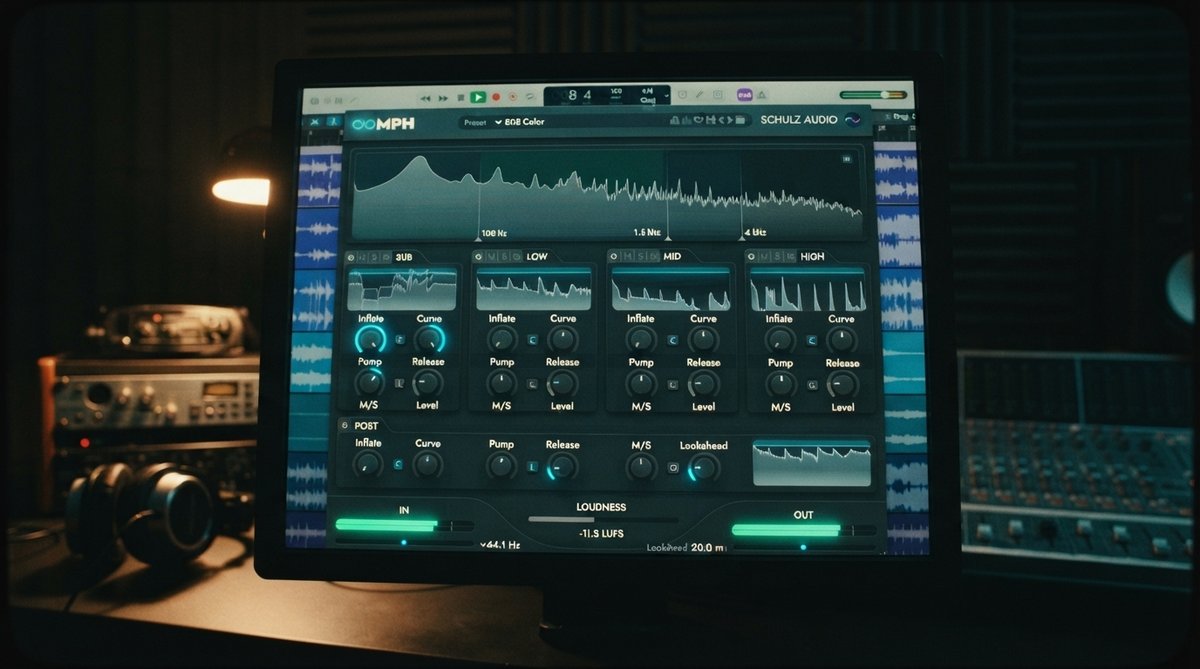
Our plugin OOMPH is designed for this kind of detailed enhancement. It splits your audio into four flexible bands, allowing you to independently control saturation, balance, dynamics, and even stereo width for each frequency zone. This makes it an ideal tool for refining individual sounds or adding cohesion to mix and master busses.
Use multiband saturation to sculpt the specific character of low-end punch, midrange presence, or high-end sparkle.
Visualizing the Impact of Multiband Saturation
When applying saturation, especially multiband, it is crucial to listen critically, but visual feedback can also be incredibly helpful. A spectrum analyzer like Spectrum 2 allows you to see the new harmonics being generated in real-time across different frequency bands. This helps you understand how your saturation choices are affecting the The Art Of Spectral Balance How To Achieve A Professional Sounding Mix. An oscilloscope, such as Oszillos Mega Scope, can show you how the waveform itself is being reshaped, giving you insight into the subtle compression and clipping that saturation introduces. Using these tools in conjunction with your ears provides a comprehensive approach to tonal shaping, as discussed in Beyond The Ears Using A Spectrum Analyzer For Precise Eq Decisions.
Practical Applications and Workflow Tips
Beyond individual tracks, multiband saturation can be applied to busses or even the master channel for broader tonal enhancement. For example, you might use a touch of low-mid saturation on a drum bus to add thickness, or a gentle high-frequency saturation on a synth pad to make it shimmer. Remember that saturation is cumulative, so a little goes a long way. Always use it in context of your mix. Experiment with the Mid-Side capabilities that some multiband processors, like OOMPH, offer to apply saturation differently to the center and side information, further enhancing Frequency Specific Stereo Width Using Mid Side Processing For A Deeper Soundstage. For more ideas on creative saturation, check out Beyond Guitar Creative Saturation Techniques For Bass Drums And Synths or dive deeper into the general role of saturation in The Role Of Saturation In Modern Mixing Adding Harmonics And Warmth.