What Are Vocal Formants?
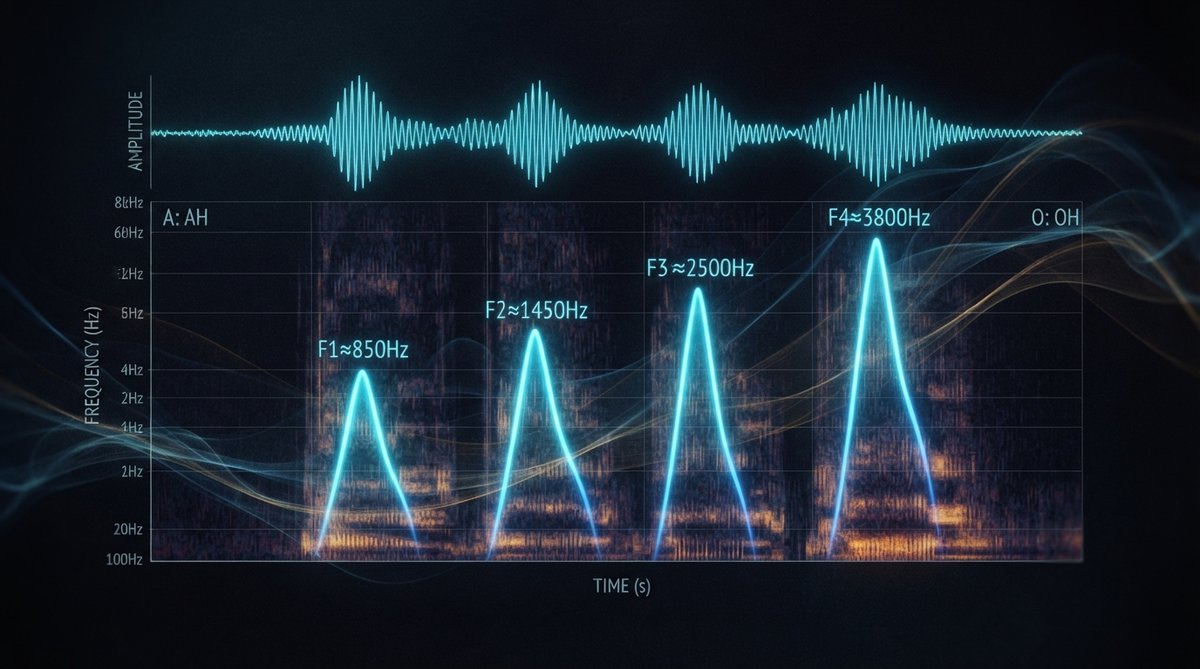
In simple terms, formants are fixed frequency resonances within the vocal tract that amplify certain harmonic partials of the fundamental vocal pitch. Think of your vocal tract (throat, mouth, nasal cavity) as a series of interconnected resonating tubes. As air passes through and your vocal cords vibrate, these tubes naturally resonate at specific frequencies, regardless of the note you are singing. These resonant frequencies are the formants.
When a singer changes pitch, the fundamental frequency and its overtones shift, but the formant frequencies themselves remain relatively constant for a given vowel sound. It is the interaction between the changing harmonic series and these stable formant regions that creates the distinct timbre of different vowels and the overall character of a voice.
Vocal formants are fixed resonant frequencies in the vocal tract that define the unique timbre and vowel sounds of a voice, independent of pitch.
Visualizing Formants in Your DAW
To understand formants better, you can observe them. Place a spectrum analyzer plug-in, like Spectrum 2, on a vocal track. Have the vocalist sing a sustained vowel sound, then change pitch while maintaining the same vowel. You will see the fundamental frequency and its harmonics moving up and down the frequency spectrum. However, you will also notice specific peaks, or 'bumps', in the frequency response that stay relatively stable in their frequency region. These are your formants.
Using a tool like Oszillos Mega Scope alongside a spectrum analyzer can give you a more complete picture of how the waveform's shape correlates with its frequency content, helping you fine-tune processing. For a deeper dive into using visual tools, consider reading Beyond The Ears Using A Spectrum Analyzer For Precise Eq Decisions and [LINK:unlock-the-power-of-audio-analysis-with-oszillos-mega-scope].
Shaping Vocal Timbre for Genre
Understanding formants gives you a powerful way to approach vocal sound design. By subtly enhancing or attenuating these specific frequency regions, you can push a vocal's character to fit a genre's demands.
Practical Application: EQ and Beyond
The primary tool for shaping formants is equalization. Using a parametric EQ, you can create broad or narrow boosts and cuts to target these resonant areas. Start with wide Q values to make subtle changes, then narrow them if you need to address a specific, problematic frequency. Always listen in context with the full mix to ensure your changes are enhancing, not detracting.
Targeting specific formant regions with EQ is key to adapting a vocal's character to different musical genres.
Multiband dynamics processors, such as OOMPH, can also be useful. By applying saturation, compression, or stereo width adjustments to specific frequency bands, you can subtly enhance or control formant regions dynamically. For example, a slight multiband saturation in an upper formant region can add harmonic richness and perceived brightness without harshness. Learn more about this in Mastering Multiband Dynamics Shaping Your Mix With Frequency Specific Control.
Remember, the goal is often to enhance or gently guide the natural vocal performance, not to completely transform it into something it is not. Subtlety is usually the most effective approach when working with formants.