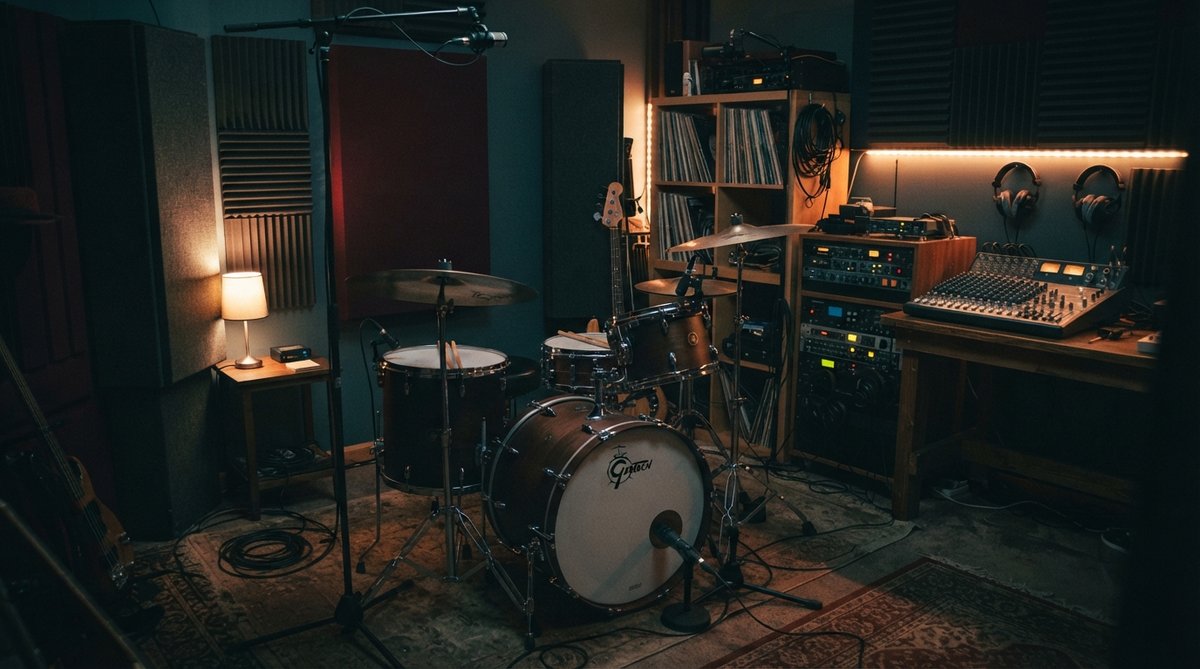
Acoustic Treatment: Taming the Room
The first step to getting a big drum sound in a small room is to address the room itself. Small spaces are notorious for problematic reflections, standing waves, and muddy low end. You do not need to build a professional studio, but some strategic acoustic treatment can make a world of difference. Focus on these areas:
- Absorption: Place acoustic panels or thick blankets at primary reflection points (where sound bounces off walls into your microphones). This helps reduce flutter echoes and control overall decay time.
- Bass Traps: Crucial for small rooms. Corner bass traps are highly effective at taming low frequency buildup, which can make your kick drum and floor tom sound boomy and undefined. Even DIY solutions can help significantly.
- Diffusion: While absorption is key, some diffusion can prevent the room from sounding too dead. A bookshelf filled with books or strategically placed diffusers can help scatter remaining reflections, adding a sense of space without creating muddy resonances. For more on optimizing your recording environment, check out Optimizing Your Studio Space Understanding Room Acoustics For Better Mixes.
Even minimal acoustic treatment can dramatically improve drum recordings in a small room, transforming problematic reflections into controlled ambiance.
Smart Microphone Techniques for Limited Spaces
When your room is small, microphone choice and placement become even more critical. The goal is to capture the drums directly and minimize undesirable room sound.
- Kick Drum: Use two microphones if possible: one inside the kick for attack and definition, and one outside for body. Experiment with distance; moving the outside mic just a few inches can drastically change the low end. A dedicated kick mic is ideal, but a large diaphragm condenser can also work well.
- Snare Drum: A single dynamic microphone on top is often enough. Aim it towards the center for crack or towards the rim for more body. If you use a bottom mic, be very aware of phase issues. Use Oszillos Mega Scope to visually align the waveforms of your top and bottom snare mics to ensure they are in phase, preventing thinness or cancellation. You can learn more about this in The Power Of Phase Understanding And Manipulating Phase In Your Mix.
- Overheads: This is where small rooms can be tricky. Instead of wide stereo overheads that capture too much room, consider closer, tighter placements. The Glyn Johns technique or a modified recorderman setup can provide a great stereo image with fewer mics. Focus on capturing the kit rather than the room. For creative mic placement ideas, see Beyond The Sweet Spot Creative Microphone Placement For Unique Tones.
- Minimal Miking: Sometimes, less is more. Try recording with just a kick, snare, and one or two overheads. This reduces phase issues and often yields a more cohesive sound in a challenging space.
Leveraging Post-Processing for a Bigger Drum Sound
Once your drums are recorded, the mixing stage offers powerful tools to enhance their sound, especially when compensating for a less than ideal recording environment.
- EQ and Filtering: Small rooms can lead to muddy low-mids and resonant frequencies. Use high-pass filters to clean up unnecessary low end on snare, toms, and overheads. Employ Spectrum 2 to identify problematic frequency buildups across your drum tracks. Its multi-channel display helps pinpoint clashing frequencies, which is invaluable for achieving a clear mix, as discussed in Identifying And Fixing Frequency Clashes For A Crystal Clear Mix.
- Compression and Dynamics: Judicious compression can add punch and sustain. OOMPH is excellent for this. Its multiband dynamic enhancement allows you to maximize the impact of specific frequency zones on your drums, adding punch and clarity where needed without over-compressing the entire signal. You can apply it to individual drums or the entire drum bus for cohesion.
- Artificial Reverb: Since your small room might not provide a great natural reverb, use high-quality artificial reverb to create the illusion of a larger space. RedVerb 2 lets you load impulse responses of various rooms and spaces, giving you precise control over size and decay. For a classic, characterful sound, JP-ME-1 emulates an iconic 80s digital reverb, offering twelve distinct sounds perfect for adding retro depth. Explore these options further in Convolution Reverb Explained Mastering Impulse Responses For Realistic Spatial Effects and The Definitive Guide To 80S Digital Reverb Crafting Retro Soundscapes.
- Creative Saturation: For added character and warmth, try applying subtle saturation. Schulz PortaCrunch 424 can impart the iconic tone of a vintage cassette recorder preamp, adding warmth, gentle compression, and even gritty overdrive to individual drum tracks or a close room mic. This can be a great way to give drums recorded in a small space a unique, lo-fi appeal.
Do not be afraid to replace a poor room sound with expertly crafted artificial reverb and character plugins to achieve a professional drum mix.
Embrace the Limitations
A small room does not have to be a hindrance; it can be an opportunity for a unique drum sound. Many iconic records were made in less than ideal spaces. By focusing on smart treatment, precise microphone techniques, and powerful mixing tools, you can achieve a big, impactful drum sound no matter the size of your recording space.
Remember, the goal is to capture the best possible source sound given your constraints, then enhance and shape it in the mix. With tools like Oszillos Mega Scope for phase accuracy, Spectrum 2 for frequency analysis, OOMPH for dynamic shaping, and RedVerb 2 or JP-ME-1 for spatial effects, you are well-equipped to make your drums sound huge.