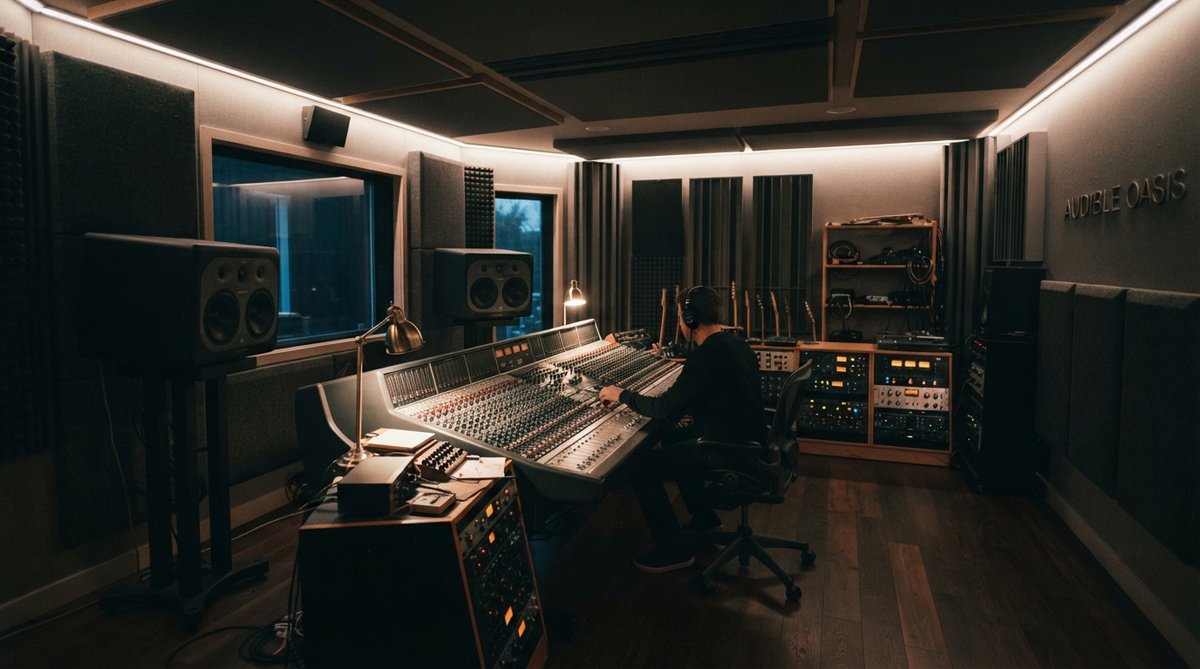
Why Room Acoustics Matter for Your Mixes
When you listen to music in your studio, you're not just hearing the direct sound from your speakers. You're also hearing reflections off walls, ceilings, floors, and furniture. These reflections arrive at your ears at different times and with varying frequency content, coloring your perception of the sound. An untreated room can make accurate mixing nearly impossible, leading to mixes that sound great in your studio but fall apart elsewhere.
Direct Sound, Early Reflections, and Reverb
To optimize your listening environment, it helps to distinguish between three types of sound reaching your ears:
- Direct Sound: This is the sound traveling straight from your speakers to your ears. Ideally, this should be the dominant sound you hear.
- Early Reflections: These are the first reflections that bounce off nearby surfaces (like your desk, side walls, or ceiling) and reach your ears shortly after the direct sound. They can cause comb filtering and phase issues, making certain frequencies sound louder or quieter than they actually are. Visualizing these with tools like Oszillos Mega Scope can highlight phase problems. Understanding how these reflections affect your listening is key to The Power Of Phase Understanding And Manipulating Phase In Your Mix.
- Reverb (Reverberation): This is the collection of all later, diffuse reflections that create the sense of a room's size and character. While natural room reverb is part of the listening experience, excessive or uneven reverb can muddy your mix. This natural reverb is distinct from artificial reverbs like RedVerb 2 or JP-ME-1, which you apply intentionally to create desired spaces in your music.
A well-treated room ensures your ears perceive the direct sound from your monitors as clearly as possible, allowing for more accurate mixing decisions.
Common Acoustic Problems and Their Solutions
Several acoustic issues commonly plague home studios:
- Standing Waves (Room Modes): These occur when sound waves reflect between parallel surfaces, causing certain frequencies to be exaggerated or canceled out at different points in the room. This often leads to inaccurate bass response. You might hear too much bass in one spot and too little in another.
- Flutter Echoes: Rapid, distinct echoes between two parallel, reflective surfaces (like bare walls). They can create a metallic, distracting sound.
- Excessive Reverb Time: If your room is too live, sounds will linger too long, blurring transients and making it hard to hear details. This impacts your ability to achieve The Art Of Spectral Balance How To Achieve A Professional Sounding Mix.
Addressing these problems often involves a combination of acoustic treatments:
- Absorption: Materials like foam panels, mineral wool, or fiberglass absorb sound energy, reducing reflections and reverb time. They are crucial at first reflection points (where sound first bounces from speakers to your ears) and for general decay control.
- Diffusion: Diffusers scatter sound waves in multiple directions, breaking up flutter echoes and creating a more even sound field without removing too much energy. They are often placed on rear walls.
- Bass Traps: These specialized absorbers are designed to tame low-frequency standing waves. They are essential for achieving accurate bass response and are typically placed in corners where low frequencies tend to build up. Using a tool like Spectrum 2 can help you identify problematic frequencies in your room's response, guiding your bass trap placement and overall EQ decisions. For more on this, read Beyond The Ears Using A Spectrum Analyzer For Precise Eq Decisions.
Optimizing Monitoring and Speaker Placement
Even with perfect room treatment, poor monitor placement can undermine your efforts. The goal is to create an equilateral triangle between your two speakers and your listening position (the "sweet spot").
- Speaker Height: Tweeters should generally be at ear level.
- Distance from Walls: Avoid placing speakers flush against walls, as this can exaggerate bass frequencies. Experiment with distance to find a balanced sound.
- Symmetry: Ensure your setup is as symmetrical as possible, with equal distances to side walls, to maintain a balanced stereo image. For a deeper dive into setting up your listening environment, check out [LINK:optimizing-your-studio-monitoring-environment-from-room-treatment-to-speaker-placement].
Accurate monitoring starts with a well-positioned sweet spot in a controlled acoustic environment.
Using Analysis Tools to Diagnose Your Room
While your ears are the ultimate judge, visual analysis tools can reveal issues you might not immediately perceive. A multi-channel spectrum analyzer like Spectrum 2 can help you measure the frequency response of your room. By playing pink noise through your monitors and analyzing the sound at your listening position, you can identify peaks and dips in the frequency spectrum caused by room modes or reflections. This insight is invaluable for Identifying And Fixing Frequency Clashes For A Crystal Clear Mix in your actual mixes. Similarly, Oszillos Mega Scope allows you to visualize waveforms and phase relationships, helping you see how reflections might be affecting the coherence of your sound, especially in the low end. It's a powerful companion to your ears, improving your Developing Your Critical Listening Skills Ear Training For Mix Engineers.
Conclusion
Optimizing your studio space for better acoustics is one of the most impactful steps you can take to improve your mixes. By understanding how sound behaves in your room, strategically applying acoustic treatment, and carefully positioning your monitors, you create a reliable listening environment. This foundation allows you to make more confident mixing decisions that translate well to any playback system.