What is Saturation?
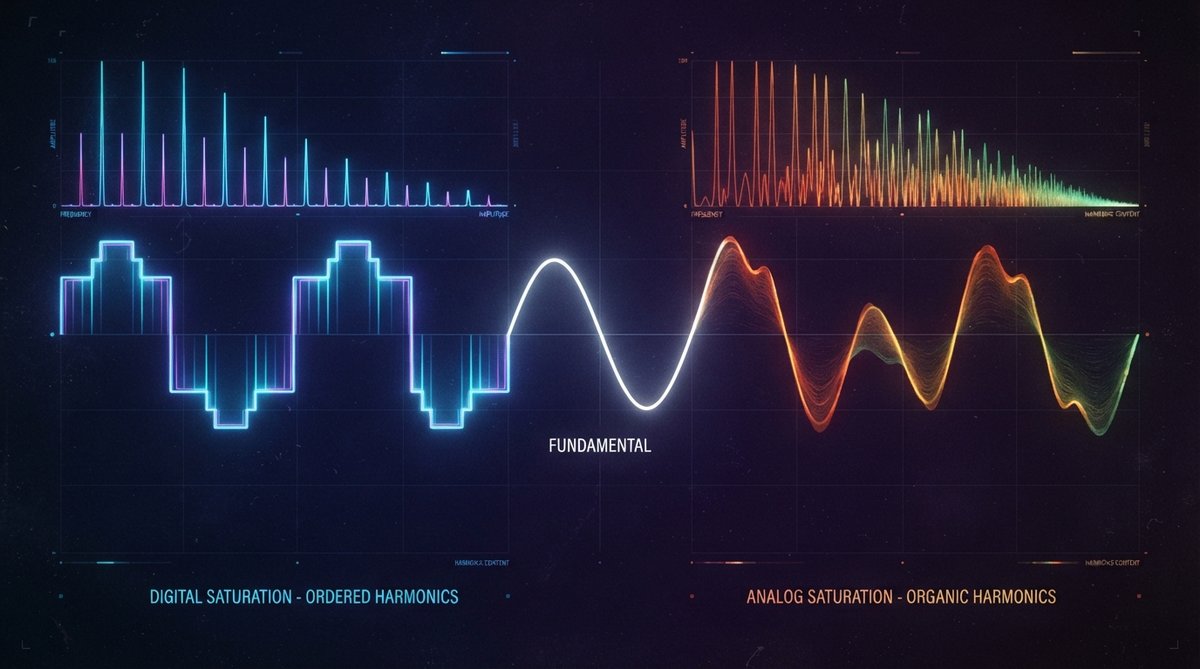
At its core, saturation involves adding harmonic overtones to an audio signal and often introduces a subtle form of compression. This process enriches the sound, making it feel fuller, louder, and more present without necessarily increasing its peak level. It can smooth out transients, add perceived loudness, and infuse a sense of 'mojo' that makes a track come alive. If you want a deeper dive into the general concept, read our article on The Role Of Saturation In Modern Mixing Adding Harmonics And Warmth.
The Sound of Analog Saturation
Analog saturation originates from the natural behavior of physical components like tubes, transistors, and magnetic tape when pushed past their linear operating range. This results in a complex generation of harmonics, often with a prevalence of even-order harmonics (octaves), which our ears perceive as pleasing and musical. Analog saturation also typically includes a gentle, musical form of compression, smoothing out dynamic peaks and adding a natural 'glue' to the sound. It often imparts a sense of warmth, depth, and a subtle softening of transients.
Analog saturation adds complex, musical harmonics and natural compression, creating warmth and a cohesive feel.
Think of the rich sound of a guitar amplifier pushed into overdrive, the subtle thickening from a vintage console's preamps, or the characteristic warmth of tape. Our Schulz Tonebreaker plugin, with its True Circuit Simulation, faithfully recreates the dynamic response and harmonic richness of a classic British blues overdrive pedal. Similarly, Schulz PortaCrunch 424 captures the distinct character of a 90s cassette four-track preamp, offering everything from warm cleans to saturated fuzz, demonstrating how different analog gear imparts unique flavors. For more on this, check out Unlocking The Magic Of Preamp Gain From Clean Warmth To Gritty Overdrive and How To Get That Authentic Cassette Tape Sound In Your Daw.
The Precision of Digital Saturation
Digital saturation, on the other hand, is achieved through algorithms. This allows for incredibly precise control over the type and amount of harmonic content generated. Digital saturation can emulate analog characteristics very closely, but it also offers possibilities that go beyond physical hardware. You can precisely dial in specific harmonic series, apply saturation to only certain frequency bands, or create extreme, aggressive distortions with surgical accuracy. While analog often has a 'sweet spot', digital saturation can be pushed further with more predictable results, or designed to be perfectly clean and transparent in its harmonic addition.
Digital saturation offers surgical control over harmonic content, enabling both precise emulation and unique, aggressive sound design.
Plugins like OOMPH exemplify this control. OOMPH is a multi-band dynamic enhancement plugin that lets you independently control saturation within four flexible frequency zones, along with dynamics, balance, and stereo width. This level of frequency-specific control is where digital saturation truly shines, allowing you to add warmth to a bassline's low-mids without muddying the sub, or to enhance the presence of a vocal's upper harmonics without adding harshness to the sibilance. To understand more about this technique, read The Power Of Multiband Saturation Adding Warmth Character To Specific Frequencies.
When and How to Use Them
Choosing between digital and analog saturation often comes down to the desired character and level of control. * Use Analog Saturation (or its emulations) when: You want to add organic warmth, subtle glue, and a natural thickening effect. It's excellent for bus processing (drums, vocals, entire mix), giving individual instruments like bass, guitars, or synths more character and sustain. It helps elements sit together in a mix more cohesively. Consider it for achieving a vintage or 'broken-in' feel. * Use Digital Saturation when: You need precise control over the harmonic content, want to target specific frequency ranges, or aim for cleaner, more aggressive, or experimental distortion. It's ideal for sound design, adding specific presence to an instrument without coloring the whole signal, or achieving modern, crisp harmonic enhancement. It's also great for parallel processing, blending a saturated signal with a clean one to retain punch while adding richness (Mastering Parallel Saturation Blending Clean And Driven Signals).
Visualizing Saturation
No matter which type you choose, it's always helpful to see what saturation is doing to your audio. Tools like Oszillos Mega Scope can show you how the waveform is being subtly reshaped and compressed, while Spectrum 2 will clearly display the new harmonic content being generated across the frequency spectrum. Using these visual aids alongside your ears can help you make more informed decisions about your saturation choices. Learn more about these tools in Oszillos Mega Scope Multi Channel Audio Oscilloscope Plug In and Spectrum 2 The Ultimate Multi Channel Spectrum Analyser Plug In.
Conclusion
Both digital and analog saturation are invaluable tools, each with unique strengths. Understanding their differences allows you to consciously choose the right approach for your production goals, whether it's adding a touch of vintage warmth or crafting a distinctly modern, aggressive tone. Experiment with both, listen critically, and let your ears guide you to the perfect amount of harmonic richness. For more creative applications, explore Beyond Guitar Creative Saturation Techniques For Bass Drums And Synths and The Art Of Harmonic Layering Building Richer Tones With Saturation And Synthesis.