The Challenge of the Low End
The low-frequency range, typically below 200 Hz, is where bass guitars, kick drums, and sub-bass synths reside. When multiple instruments occupy this space, they can quickly mask each other, leading to a muddy, indistinct mix. This often comes down to two main issues: frequency clashes where instruments compete for the same frequency real estate, and phase issues where their waveforms interfere with each other, causing cancellations or boosts that aren't musically desirable.
Visualizing Low-End Interactions
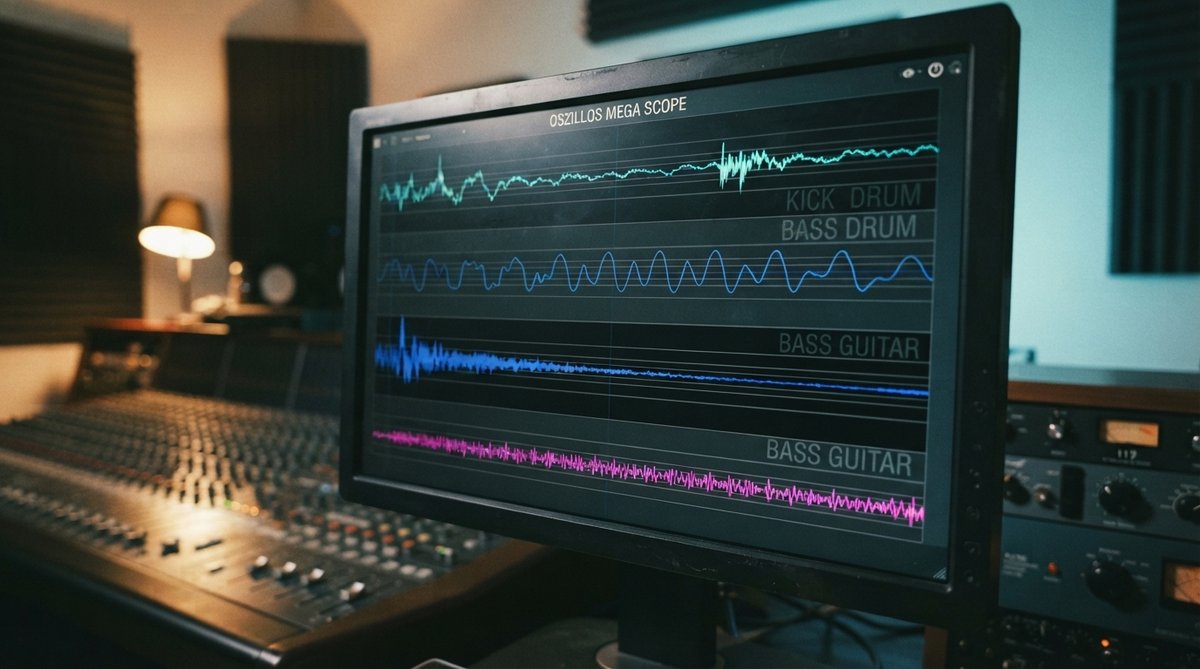
While your ears are the ultimate judge, visual feedback can dramatically speed up the process of identifying and fixing low-end problems. An oscilloscope, for example, allows you to literally see the waveforms of your bass instruments. If you place Oszillos Mega Scope on both your kick and bass tracks and route them to separate inputs within the plugin, you can observe their waveforms side-by-side or overlaid. This immediately highlights timing discrepancies and phase cancellations, showing you exactly how they interact in real time. You can learn more about this powerful tool in our article, Oszillos Mega Scope Multi Channel Audio Oscilloscope Plug In.
An oscilloscope reveals the timing and phase relationships between your low-end elements, helping you pinpoint hidden clashes.
Beyond waveforms, a spectrum analyzer provides a visual map of your mix's frequency content. When your bass and kick sound muddy, it's often because they have significant energy in the same frequency bands. Spectrum 2 allows for multi-channel analysis, so you can overlay the frequency curves of your kick, bass, and any other low-end elements. This visual representation instantly shows you where the dominant frequencies lie for each instrument and where they are competing. Identifying these overlapping areas is the first step toward creating separation and clarity. For more on using this, check out Spectrum 2 The Ultimate Multi Channel Spectrum Analyser Plug In and Beyond The Ears Using A Spectrum Analyzer For Precise Eq Decisions.
Practical Techniques for a Tidy Bass
Once you've visualized the issues, you can apply targeted solutions. Here are some common approaches:
- **EQ: Use subtractive EQ to carve out space for each instrument. If your kick has a strong punch around 60 Hz, you might gently dip the bass guitar's presence in that region. Conversely, if your bass has melodic information around 100 Hz, you might reduce the kick's energy there. The goal is to give each element its own pocket in the low end. This contributes to overall The Art Of Spectral Balance How To Achieve A Professional Sounding Mix.
- **Sidechain Compression: A classic technique for a tight low end. By sidechaining your bass guitar (or other bass elements) to the kick drum, the bass will duck slightly whenever the kick hits. This creates rhythmic clarity and prevents them from clashing dynamically. You can observe the effect of your compressor settings directly in Oszillos Mega Scope.
- **Mid-Side Processing: For subtle adjustments, consider using mid-side EQ on your bass. You can narrow the stereo width of the very lowest frequencies (e.g., below 80 Hz) to keep them mono and focused, while allowing higher bass frequencies to spread out slightly. OOMPH offers multiband dynamic enhancement with M/S capabilities, allowing you to refine specific frequency zones.
Effective low-end management combines precise EQ, dynamic sidechaining, and intelligent stereo placement.
Remember, the aim is not to eliminate frequencies entirely, but to manage their interactions so each instrument has its moment to shine. Using tools like the Oszillos & Spectrum Bundle gives you the comprehensive visual feedback needed to make informed decisions and achieve a powerful, clean low end. This approach helps in Crafting Punchy And Clear Basslines across your entire mix.