The Low-End Foundation in Trance
In genres like trance, the kick drum and bassline aren't just elements; they're the rhythmic and harmonic engine. They need to work together seamlessly to drive the track forward, creating that undeniable groove and power that gets bodies moving. When they clash, the entire mix can feel weak, muddy, or lose its sense of propulsion. This is especially true in the sub-bass frequencies, where even small misalignments can have a huge impact.
Understanding Phase and Timing Conflicts
Phase refers to the position of a waveform in its cycle. When two similar waveforms, like a kick and a bass, occupy the same frequency range at the same time, their phase relationship becomes critical. If their peaks and troughs align, they sum constructively, increasing loudness and impact. If they oppose each other (one is peaking while the other is in a trough), they sum destructively, leading to phase cancellation. This often results in a thin, hollow, or disappearing low end. Timing issues, where one element hits slightly before or after the other, can also create a less impactful or 'flamming' feel, even without severe phase cancellation. You can learn more about this in our article The Power Of Phase Understanding And Manipulating Phase In Your Mix.
Destructive phase cancellation in the low end is a common culprit for weak-sounding kick and bass combinations.
Visualizing Your Low End with Oszillos Mega Scope
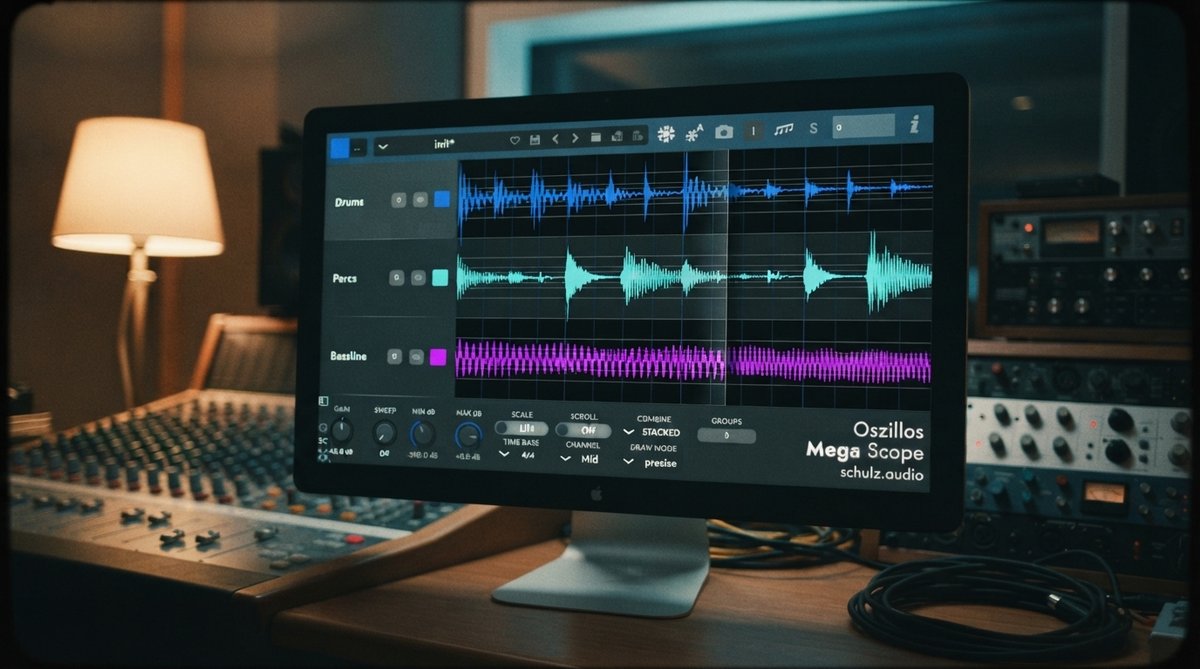
While your ears are the ultimate judge, visual tools can dramatically speed up the diagnostic process, especially for complex low-end interactions. This is where Oszillos Mega Scope becomes invaluable. As a BPM-synced oscilloscope with support for multiple inputs, it allows you to see the waveforms of your kick and bass simultaneously in real-time. This visual feedback helps you pinpoint exactly where timing and phase issues are occurring, making it easier to make precise adjustments. For a deeper dive into its capabilities, check out Oszillos Mega Scope Multi Channel Audio Oscilloscope Plug In.
Oszillos Mega Scope's multi-input display allows you to directly compare kick and bass waveforms, revealing hidden low-end conflicts.
Step-by-Step Alignment Using Oszillos Mega Scope
Here's a practical workflow to align your kick and bass using Oszillos Mega Scope:
- Setup Oszillos Mega Scope: Insert an instance of Oszillos Mega Scope onto a dedicated low-end bus or your master bus. Route your individual kick and bass tracks to separate inputs of the oscilloscope. This lets you see both waveforms overlaid.
- Observe Initial Transients: Play a section of your track where the kick and bass hit together. Pay close attention to the initial attack of both waveforms. Are they starting at precisely the same moment? Do their initial peaks align?
- Adjust Timing with Track Delay: If the transients are slightly off, use your DAW's track delay compensation (sometimes called 'track offset' or 'delay') on either the kick or the bass track. Nudge one forward or backward by a few milliseconds and observe how the waveforms on Oszillos Mega Scope shift. Aim for perfectly aligned initial transients for maximum punch. Our article Mastering Drum Transients Visualizing Your Drum Programming For Impact And Groove offers more on transient visualization.
- Check Phase Relationship: After aligning transients, look at the sustained body of the kick and bass, especially in the sub-frequency range. Are their main cycles moving in the same direction (both positive or both negative at the same time)? Or are they opposing each other? Opposing waveforms indicate destructive phase interference.
- Apply Phase Inversion: If you identify a phase conflict, insert a utility plugin (many EQs also have a phase invert button) on either the kick or the bass track. Flip the phase (often a '180-degree phase invert' option). Watch Oszillos Mega Scope to see how the waveform changes. Does it now align more constructively with the other element? Listen to the difference; often, the low end will suddenly feel much fuller and more powerful. This is particularly effective with synthesized bass sounds.
- Fine-Tune and Listen: Continue to make small adjustments to timing and phase, always referring back to both the visual feedback from Oszillos Mega Scope and your ears. The goal is a low end that feels solid, clear, and impactful.
Beyond Basic Alignment: Sidechain and Frequency Insights
The visual insight from Oszillos Mega Scope is also fantastic for setting up sidechain compression between your kick and bass. You can see how the bass ducks out of the way of the kick, allowing you to fine-tune the compressor's attack and release times for a perfect 'pump' without over-compressing. We cover this in depth in Beyond The Pump Mastering Sidechain Compression With Visual Feedback. For broader frequency analysis to identify other clashes, consider using Spectrum 2, which can show you where different elements overlap in the frequency spectrum. You can get both tools as part of the Oszillos & Spectrum Bundle for a discounted price. This can help you with Identifying And Fixing Frequency Clashes For A Crystal Clear Mix that might not be purely phase-related.
Achieving a tight, powerful low end in trance music is a combination of careful listening and precise adjustments. By leveraging the visual feedback of Oszillos Mega Scope, you can demystify phase and timing issues, leading to mixes with greater clarity, punch, and impact.