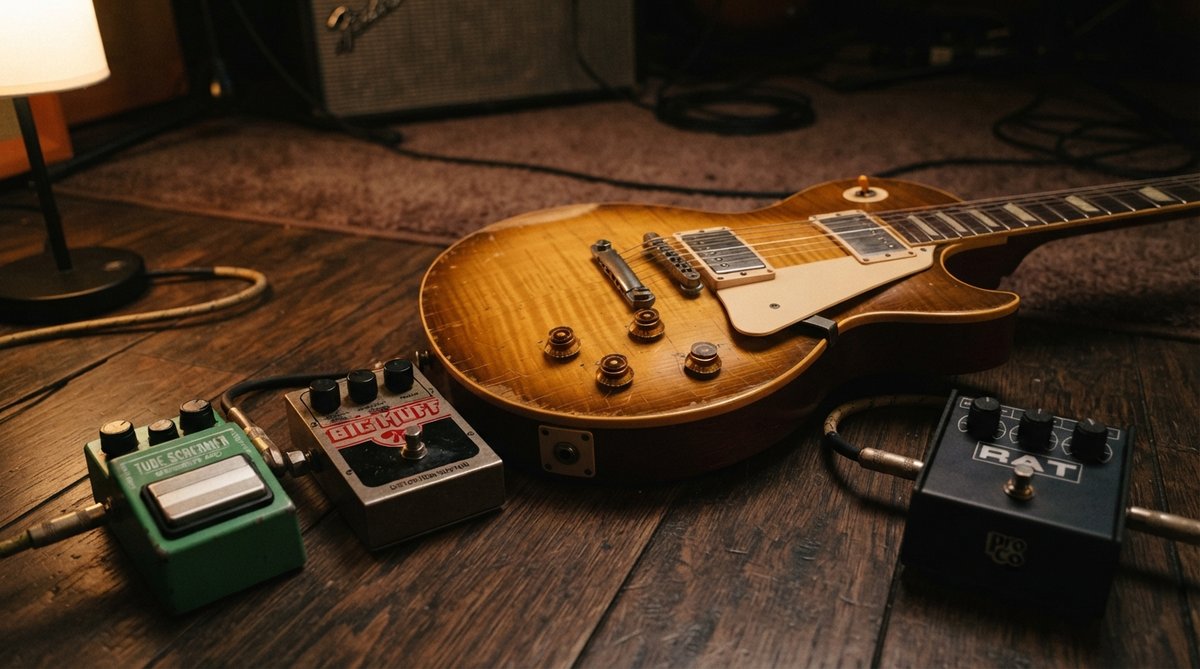
The Foundation: What is Gain and Saturation?
At its core, gain refers to the amplification of an audio signal. When you push an amplifier or a circuit beyond its clean headroom, it starts to saturate. This saturation introduces harmonic content and compression, which we perceive as warmth, grit, or sustain. The way a circuit saturates determines whether it produces overdrive, distortion, or fuzz. For a deeper look at how preamps contribute to this, check out our article on Unlocking The Magic Of Preamp Gain From Clean Warmth To Gritty Overdrive.
Gain isn't just about volume; it's about adding harmonic richness and dynamic compression to your signal.
Overdrive: The Gentle Push
Overdrive is the mildest form of saturation. It aims to emulate the sound of a tube amplifier being pushed to its natural limits. Think of it as a 'warm hug' for your signal. Overdrive circuits typically respond very dynamically to your playing touch: playing softly yields a cleaner tone, while digging in harder brings out more grit. This makes overdrive incredibly expressive.
Characteristics of overdrive include: * Soft clipping: The waveform corners are gently rounded, preserving much of the original signal's character. * Harmonically rich: Adds pleasant, musical harmonics without sounding harsh. * Dynamic response: Highly sensitive to picking dynamics and guitar volume knob adjustments. * Sustain: Increases sustain without completely squashing the transients.
Overdrive is perfect for blues, classic rock, and adding warmth to clean tones. A great example of this classic sound is captured by the Schulz Tonebreaker, which faithfully recreates a legendary British blues overdrive, complete with amp and cabinet modeling for an immersive experience. You can learn more about achieving this sound in your DAW by reading Crafting The Classic British Blues Guitar Tone In Your Daw.
Distortion: The Aggressive Crunch
Distortion takes the signal further than overdrive, creating a more aggressive, compressed, and sustained sound. While overdrive simulates a tube amp working hard, distortion often achieves its effect through more extreme circuit manipulation, sometimes with dedicated distortion stages. It's the sound associated with hard rock, metal, and many modern genres.
Key aspects of distortion are: * Hard clipping: The waveform is more severely squared off, leading to a thicker, more sustained sound. * Increased compression: Dynamics are more squashed, resulting in a more uniform volume. * Mid-focused: Often features a prominent midrange boost, helping guitars cut through a mix. * Less dynamic: While still responsive, it's generally less touch-sensitive than overdrive, providing a more consistent level of grit.
Distortion offers a powerful, articulate crunch suitable for heavy riffs and soaring solos. For visualizing how distortion shapes your waveform and frequency content, tools like Oszillos Mega Scope and Spectrum 2 can be invaluable. You can explore their capabilities further in [LINK:unlock-the-power-of-audio-analysis-with-oszillos-mega-scope] and Spectrum 2 The Ultimate Multi Channel Spectrum Analyser Plug In.
Fuzz: The Sonic Annihilation
Fuzz is the most extreme form of saturation, often characterized by a thick, woolly, and sometimes gated sound. It's less about emulating an amp and more about completely transforming the signal into a wall of sound. Fuzz pedals were among the earliest gain effects, developed by pushing circuits to their absolute limits, often introducing non-linear clipping and octave harmonics.
What defines fuzz? * Heavy clipping: The waveform is often severely clipped, approaching a square wave, creating a very rich harmonic spectrum. * Thick and sustained: Produces immense sustain, often bordering on feedback. * Unique harmonic content: Can introduce octave-up or octave-down harmonics, giving it a distinctive, sometimes synth-like quality. * Less clarity: Individual notes can blend into a thick texture, especially with chords.
Fuzz is the sound of psychedelic rock, doom metal, and experimental genres, known for its massive, sometimes unruly character. Our Schulz PortaCrunch 424 plugin, while primarily a preamp emulation, can deliver tones from gritty overdrive to saturated, blown-out fuzz, capturing that iconic lo-fi character that shaped 90s indie. This kind of creative saturation isn't just for guitar; it works wonders on bass, drums, and synths too, as discussed in Beyond Guitar Creative Saturation Techniques For Bass Drums And Synths.
While all three add 'dirt', overdrive is subtle and dynamic, distortion is aggressive and sustained, and fuzz is thick, woolly, and harmonically complex.
Choosing the Right Gain for Your Tone
The best way to understand these differences is to experiment. Consider the genre you're working in and the role of the instrument. Do you need a subtle boost to push an amp, a powerful crunch for a riff, or a wall of sound for a solo? Many guitarists layer these effects, using an overdrive to boost a distortion pedal, for instance, for even more complex gain staging. There are no strict rules, only creative possibilities.