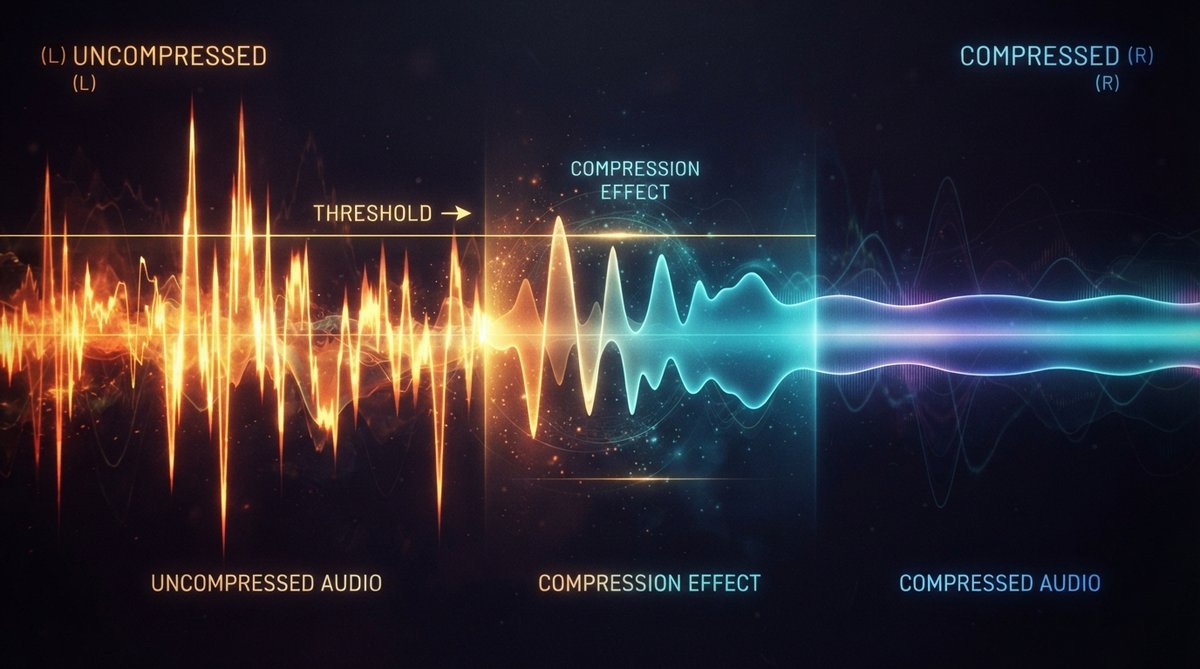
What is Compression Ratio?
Simply put, the compression ratio determines how much your signal is reduced after it crosses the set threshold. It's expressed as a ratio, like 2:1 or 8:1. The first number represents the input signal's change above the threshold, and the second number represents the resulting output signal's change. For example, a 2:1 ratio means that for every 2dB the input signal goes above the threshold, the output signal will only increase by 1dB. A 1:1 ratio means no compression is applied, while an infinite:1 ratio means that once the signal hits the threshold, it won't get any louder, effectively acting as a limiter.
Subtle Glue: Low Ratios (1.5:1 to 4:1)
When you're aiming for a more transparent, natural sound, low compression ratios are your best friend. Ratios in the range of 1.5:1 to 3:1 are often used to gently even out vocal performances, smooth bass guitar dynamics, or add a subtle 'glue' to an entire mix or bus. This light touch helps elements sit better together without sounding obviously compressed. It's about bringing consistency and cohesion to the sound, making it feel more polished without losing its natural dynamic range. You might use a low ratio on a drum bus to make the kit feel more integrated, or on a vocal track to keep it present in the mix without sudden jumps in volume.
Low compression ratios are excellent for transparently evening out dynamics and adding cohesion to a mix without sounding 'processed'.
For subtle dynamic enhancement across multiple frequency bands, a tool like OOMPH can be incredibly effective. Its multiband nature allows you to apply gentle compression and saturation specifically where needed, contributing to that 'glued' sound without over-processing the entire signal. This approach is particularly useful for bus processing to achieve a cohesive macro-tone, as discussed in our article Glue Your Mix Advanced Bus Processing For Cohesion And Macro Tone Shaping.
Punch and Definition: Medium Ratios (4:1 to 8:1)
Moving up to medium ratios, typically from 4:1 to 8:1, you start to exert more noticeable control over your dynamics. These ratios are fantastic for shaping the punch and definition of individual instruments. On drums, a 4:1 or 5:1 ratio can make snares crack harder and kicks feel more impactful. For bass, it can help solidify its presence and keep it consistent. Electric guitars can benefit from these ratios to achieve a more sustained, powerful sound. When working with these ratios, paying close attention to attack and release times becomes critical to achieve the desired transient shaping. You can also visually fine-tune your compressor settings by using an oscilloscope like Oszillos Mega Scope, which lets you see exactly how the waveform reacts to your compression, helping you dial in that perfect punch. For more on visualizing dynamics, check out [LINK:unlock-the-power-of-audio-analysis-with-oszillos-mega-scope] and Mastering Drum Transients Visualizing Your Drum Programming For Impact And Groove.
Aggressive Control: High Ratios (8:1 to 20:1)
When you need to heavily reduce dynamic range or create a specific, aggressive effect, high ratios come into play. Ratios from 8:1 up to 20:1 will significantly 'squash' the dynamics, making loud parts much closer in volume to quieter parts. This can be used creatively on drums for a heavily pumped sound, often employed in parallel compression techniques to blend a heavily compressed signal with the dry signal, adding density and impact as described in [LINK:the-art-of-parallel-compression-adding-punch-and-density-to-your-mix]. Aggressive ratios can also be used on certain vocal styles or instruments where a very consistent, in-your-face sound is desired, or for special effects where you want to emphasize sustain or bring out room ambience.
High compression ratios, especially when combined with fast attack and release times, can dramatically alter transients and create a powerful, aggressive sound.
Limiting: Infinity:1
At the extreme end of the ratio spectrum is limiting, represented as infinity:1 (or ∞:1). A limiter is essentially a compressor with an extremely high ratio and a very fast attack time. Its primary purpose is to prevent the audio signal from exceeding a set maximum level, making it invaluable for protecting against clipping and maximizing the overall loudness of a mix during mastering. While it’s typically used for brickwall limiting, creative use of limiters can also be found in sound design for extreme dynamic shaping.