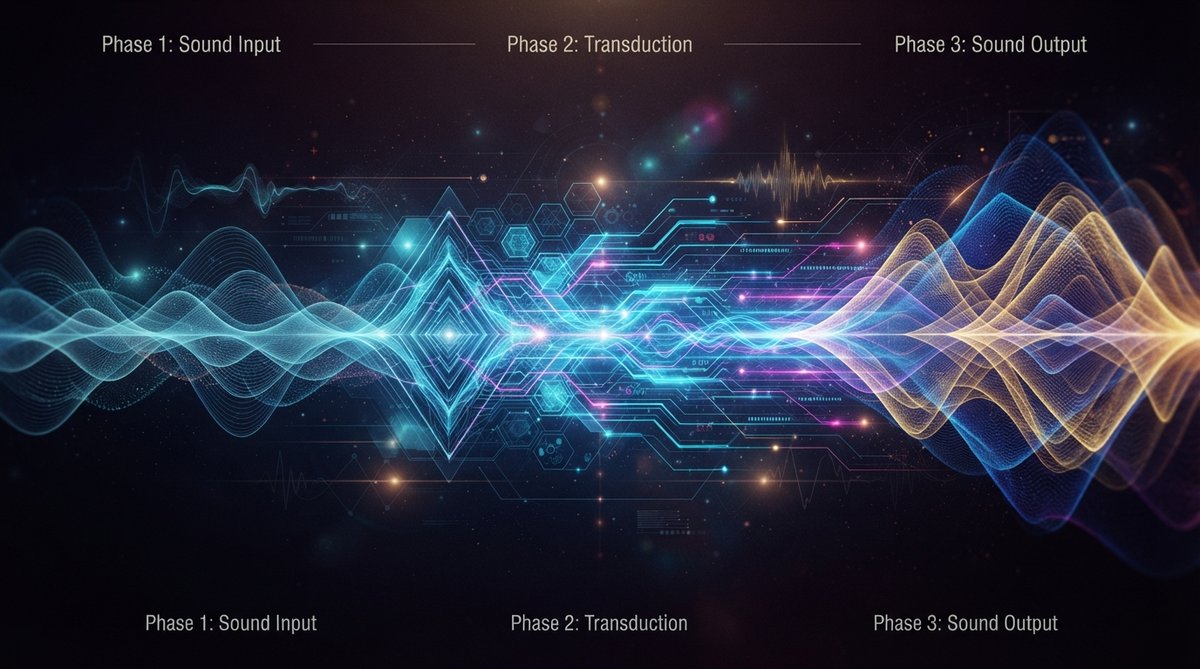
What is a Transducer?
A transducer is any device that converts energy from one form into another. In the realm of audio, we primarily deal with transducers that convert acoustic energy (sound waves) into electrical energy, and vice versa. Microphones are input transducers, and speakers are output transducers. Their performance dictates the fidelity of your recordings and the accuracy of your monitoring environment.
Microphones: Capturing the Acoustic Wave
Microphones are designed to detect minute pressure variations in the air, which we perceive as sound. When sound waves hit a microphone's diaphragm, it vibrates. This mechanical movement is then converted into an electrical signal. Different microphone types achieve this conversion in various ways:
- Dynamic Microphones: These use a coil of wire attached to a diaphragm, suspended within a magnetic field. As the diaphragm vibrates, the coil moves, inducing an electrical current. This principle is known as electromagnetic induction.
- Condenser Microphones: These feature a diaphragm and a stationary backplate, forming a capacitor. Sound waves cause the diaphragm to vibrate, changing the capacitance and thus the electrical charge. They require external power (phantom power) to operate.
- Ribbon Microphones: A thin, corrugated metallic ribbon suspended in a magnetic field serves as both diaphragm and conductor. Sound waves move the ribbon, generating an electrical current.
Regardless of the type, the goal is to convert the acoustic energy into a clean, proportional electrical signal. Monitoring this signal is crucial. Tools like an oscilloscope can help verify the integrity of the waveform captured by your microphone, allowing you to identify clipping or phase issues before they become problems. [LINK:unlock-the-power-of-audio-analysis-with-oszillos-mega-scope] provides a deeper look into visual analysis.
The microphone is the first critical link in your signal chain, directly influencing the quality of your source capture.
Speakers: Reproducing the Electrical Signal
Speakers perform the inverse function of microphones, transforming electrical signals back into audible sound waves. The core components are typically a voice coil, a magnet, and a cone (or diaphragm):
- An electrical audio signal is sent to the speaker's voice coil.
- The voice coil, being an electromagnet, reacts to the changing electrical current, causing it to rapidly move back and forth within a permanent magnetic field.
- This movement is transferred to the speaker cone, which vibrates and pushes against the surrounding air.
- These air pressure variations propagate as sound waves that reach your ears.
Speaker design also involves enclosures (cabinets) to enhance bass response and prevent phase cancellation, and crossovers to direct specific frequency ranges to appropriate drivers (woofers for low frequencies, tweeters for high frequencies). The accuracy of your speakers, combined with your room's acoustics, is paramount for making informed mixing decisions. Understanding Optimizing Your Studio Space Understanding Room Acoustics For Better Mixes is just as important as the speakers themselves.
Your speakers are the final arbiter of your mix, so accurate reproduction is non-negotiable for reliable results.
The Importance of Accurate Transduction in Audio Production
From the initial recording to the final playback, the quality of your transducers fundamentally shapes your audio. A poor microphone can introduce noise or color the sound in an undesirable way, while inaccurate speakers can lead to mixes that sound good in your studio but fall apart elsewhere.
In the digital domain, we rely on tools to help us understand what our transducers are doing. For instance, Oszillos Mega Scope allows you to visualize the waveform captured by your microphone or the signal being sent to your speakers, helping you spot anomalies like clipping or phase shifts. Similarly, Spectrum 2 provides a detailed frequency analysis, showing you the spectral content of your signal, which is invaluable for identifying issues that might stem from a microphone's response or a speaker's coloration. You can learn more about its applications in Beyond The Ears Using A Spectrum Analyzer For Precise Eq Decisions.
By understanding the physics of how these devices work, you gain a deeper appreciation for the entire audio signal chain and can make more informed choices about your gear and techniques. This knowledge empowers you to troubleshoot problems and achieve a more professional sound.