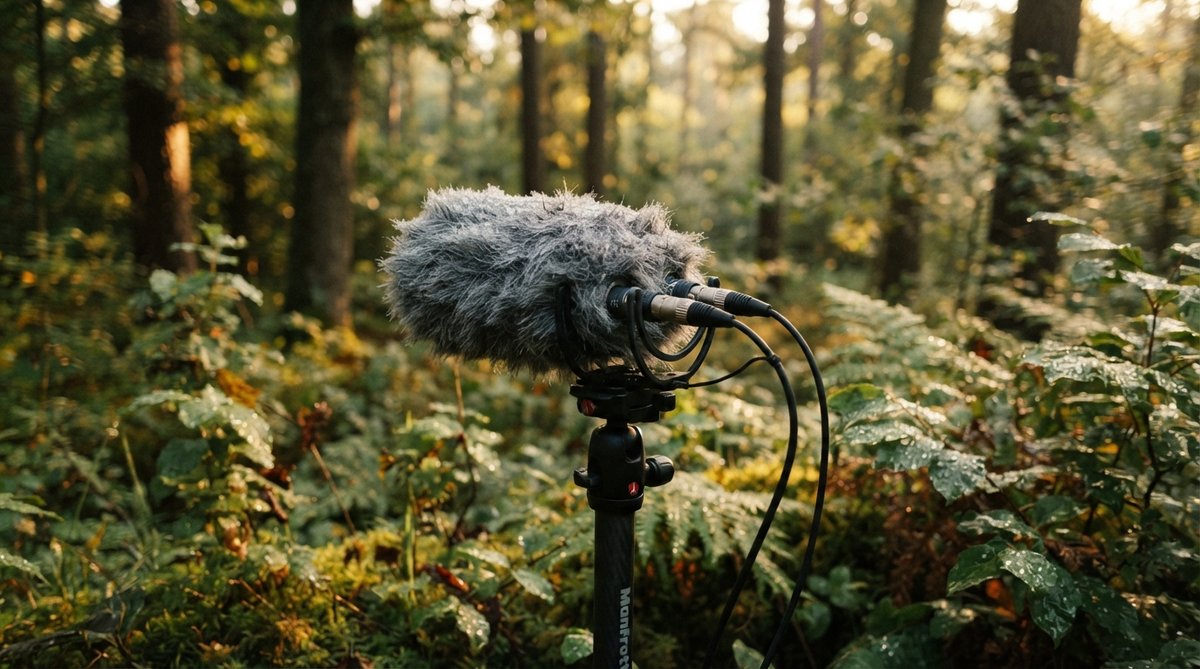
What is Field Recording?
Field recording is the art of capturing audio outside of a controlled studio environment. This could mean recording the gentle rustle of leaves in a forest, the bustling energy of a city street, or the distinct creak of an old door. These recordings become valuable raw material for various audio applications, from crafting realistic sound effects to building expansive [LINK:the-art-of-soundscape-design-creating-immersive-environments-with-audio] and adding unique textures to your music.
Essential Gear for Getting Started
While professional field recorders and specialized microphones offer the highest fidelity, you can begin with surprisingly simple equipment. Many modern smartphones have decent built-in microphones suitable for experimental captures. For more serious work, a dedicated portable recorder with external microphone inputs is a great investment. Consider stereo microphone configurations like XY or Mid-Side to capture a wider, more immersive sound.
The Art of Listening and Capturing
Successful field recording is as much about how you listen as it is about your gear. Pay attention to the subtle nuances of your environment: the distinct sonic characteristics of different surfaces, the way sound reflects and decays, and the presence of unwanted noise. * Microphone Placement: Experiment with mic positions to capture different perspectives. Placing a microphone close to a source emphasizes detail, while a more distant placement captures the acoustic space. * Monitoring: Always monitor your recordings with headphones to identify any issues like wind noise, handling noise, or unexpected background sounds. * Gain Staging: Set appropriate recording levels to avoid clipping while ensuring a strong signal. Understanding your recorder's preamps is key. You can learn more about managing audio levels in our article on The Art Of Mastering Gain Staging Keeping Your Signal Clean.
Every environment holds a unique sonic signature waiting to be discovered and repurposed for your creative projects.
Field Recording for Sound Design
Raw field recordings are perfect for creative sound design. Imagine transforming the metallic clang of a construction site into futuristic weapon sounds, or pitching down a bird's call to create an alien creature vocal. The possibilities are endless. After capturing sounds, you will bring them into your DAW for manipulation. Tools like Oszillos Mega Scope can be invaluable here, letting you visualize the waveforms of your recorded sounds. This visual feedback helps you understand transients, decay, and overall dynamic shape, which is crucial when processing these sounds with effects like compression or gates. Similarly, Spectrum 2 allows you to analyze the frequency content of your recordings, helping you identify and clean up unwanted noise or boost interesting spectral elements. You can read more about visual analysis in [LINK:unlock-the-power-of-audio-analysis-with-oszillos-mega-scope] and Spectrum 2 The Ultimate Multi Channel Spectrum Analyser Plug In.
Crafting Realistic Foley and Sound Effects
Field recording is the backbone of The Art Of Foley And Sound Effects Recording And Designing Realistic Audio For Visuals for film, television, and games. Need the specific sound of footsteps on gravel, a car door slamming, or a sword clanging? Capturing these sounds in their natural environment provides unmatched realism. Once recorded, you can refine these sounds. For example, to give a specific "room tone" or sense of space to a foley recording, you might use a reverb plugin. RedVerb 2 allows you to load impulse responses, which can be custom-recorded room ambiences, giving your foley a truly authentic spatial feel. If you are aiming for a retro or stylized feel, JP-ME-1 offers iconic 80s digital reverb sounds that can instantly transport your foley into a different sonic era, creating unique textures that are anything but realistic, yet highly evocative. Learn more about different reverb types in Algorithmic Vs Convolution Vs Hybrid Choosing The Right Reverb For Your Sound.
Field recordings provide an authentic foundation for foley, allowing you to capture the precise sonic details needed to immerse an audience.
Building Immersive Soundscapes
Soundscapes are ambient recordings that evoke a sense of place or mood. They are crucial in film for setting scenes, in games for creating immersive worlds, and in music for adding atmospheric layers. Field recordings of natural environments, urban hums, or even abstract machine noises can form the core of a compelling soundscape. After capturing a foundational ambience, you can manipulate it to enhance its impact. For instance, OOMPH can be used to add punch and clarity to specific frequency ranges within your soundscape, making certain elements stand out or giving the overall ambience more presence. Its multiband capabilities allow you to shape the dynamics and stereo width of different frequency zones, creating a truly expansive and detailed sonic environment. For a more lo-fi, gritty character, Schulz PortaCrunch 424 can introduce the warmth and saturation of vintage cassette recorders, transforming a clean field recording into something nostalgic or even dystopian. This can be especially effective for creating unique textures and atmospheres. Explore more creative saturation techniques in The Role Of Saturation In Modern Mixing Adding Harmonics And Warmth.
Integrating Field Recordings into Your Music Production
Do not limit field recordings to film or game audio. They can be powerful elements in music production too. Use them as percussive elements, textural drones, or unique transitions. A distorted recording of an engine can become a powerful bass layer, or a pitched-up recording of water droplets can form a unique melodic motif. The key is experimentation and creative processing. By bringing the sounds of the world into your studio, you gain an unlimited palette for sonic exploration.